Blueprints for Calm
Originally written: 02 February 2026
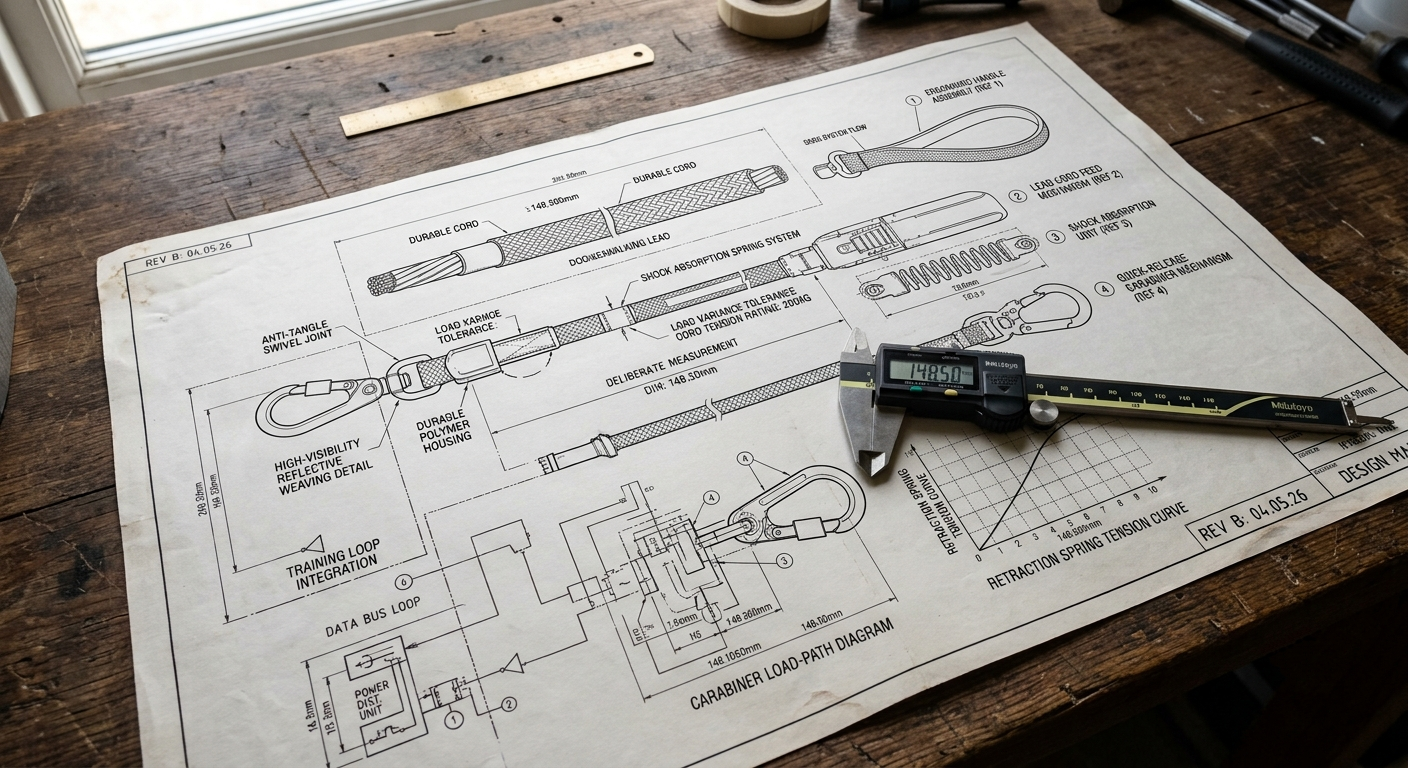
Making sure future failures are gentler than past ones.
We finally have clean, finalized diagrams. These aren't the broad marketing renderings or the loose conceptual sketches we relied on during the early, frantic phases of development; these are actual, precise system maps. To successfully transition from a chaotic prototype to a genuinely reliable product, every single physical variable has to be thoroughly mapped and accounted for. Our current schematics explicitly lay out our core structural mechanics. We are tracking exactly how force travels through the lead from the dog to the handler's hand, defining the absolute physical boundaries of our materials before structural compromise, and ensuring every interlocking interface geometry fits together with zero friction or snag points. We are mapping precisely how our selected polymers and textiles stretch, flex, and react under sudden, sharp shock loads.
While these engineering drawings look purely technical on the surface, emotionally, they function as our ultimate safety documents. Every single line on the page exists because something else failed before it. Every specific measurement exists because during a previous iteration, something slipped, twisted, pinched, overloaded, or destabilized under pressure.
Engineering drawings are a profound form of structural memory. They represent years of hard-won institutional knowledge encoded directly into geometry. Ultimately, this deep documentation is how we ensure that future failures are significantly gentler and more predictable than past ones. In that sense, they aren’t just technical artifacts—they are the true emotional infrastructure of everything we build.
— Elysia