A Prototype Isn’t a Product
Originally written: 16 March 2026
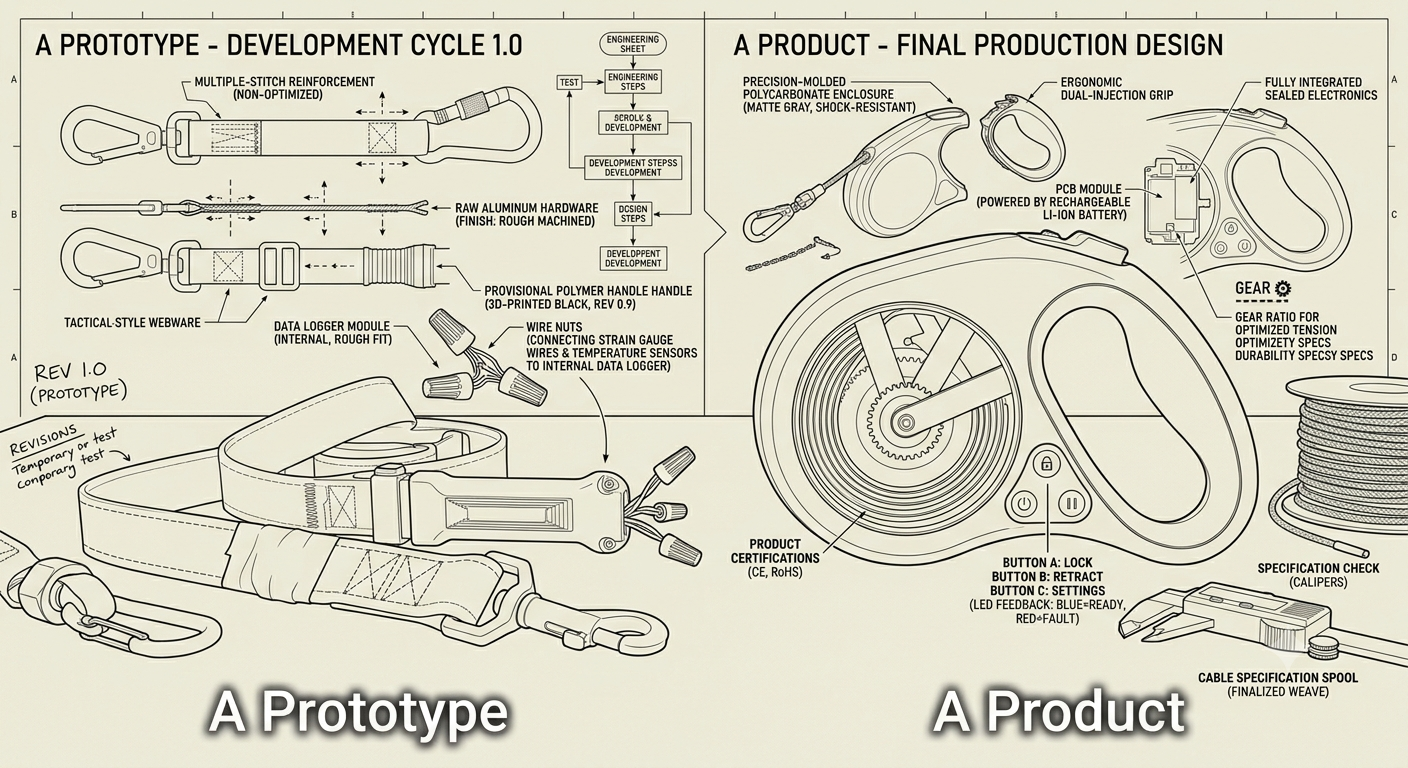
The progression of physical product to stable production.
A prototype answers targeted questions, but a finished product carries systemic responsibility. While prototypes explore geometry and basic tolerances, products must actively manage real-world risk. Prototypes can tolerate isolated failure modes, but products must be engineered to fail gently and predictably. Ultimately, prototypes belong to the internal engineering team, while products belong to the external users who rely on them for safety.
Engineering for Unpredictable Environments
We are building equipment that will live inside highly unpredictable, dynamic systems—operating around animals, humans, varying environments, high stress, rapid motion, sudden panic, and constant distraction. In these high-stakes operational contexts, rigorous iteration is not an optional phase of development; it is an ethical requirement.
The Metric for Progress
We do not advance a design forward simply because it functions correctly under ideal, controlled conditions. We only move a product toward production when we can definitively prove that when it does fail, it fails safely.