The Architecture of a Human-Factors Gap
Originally written: 1 June 2026
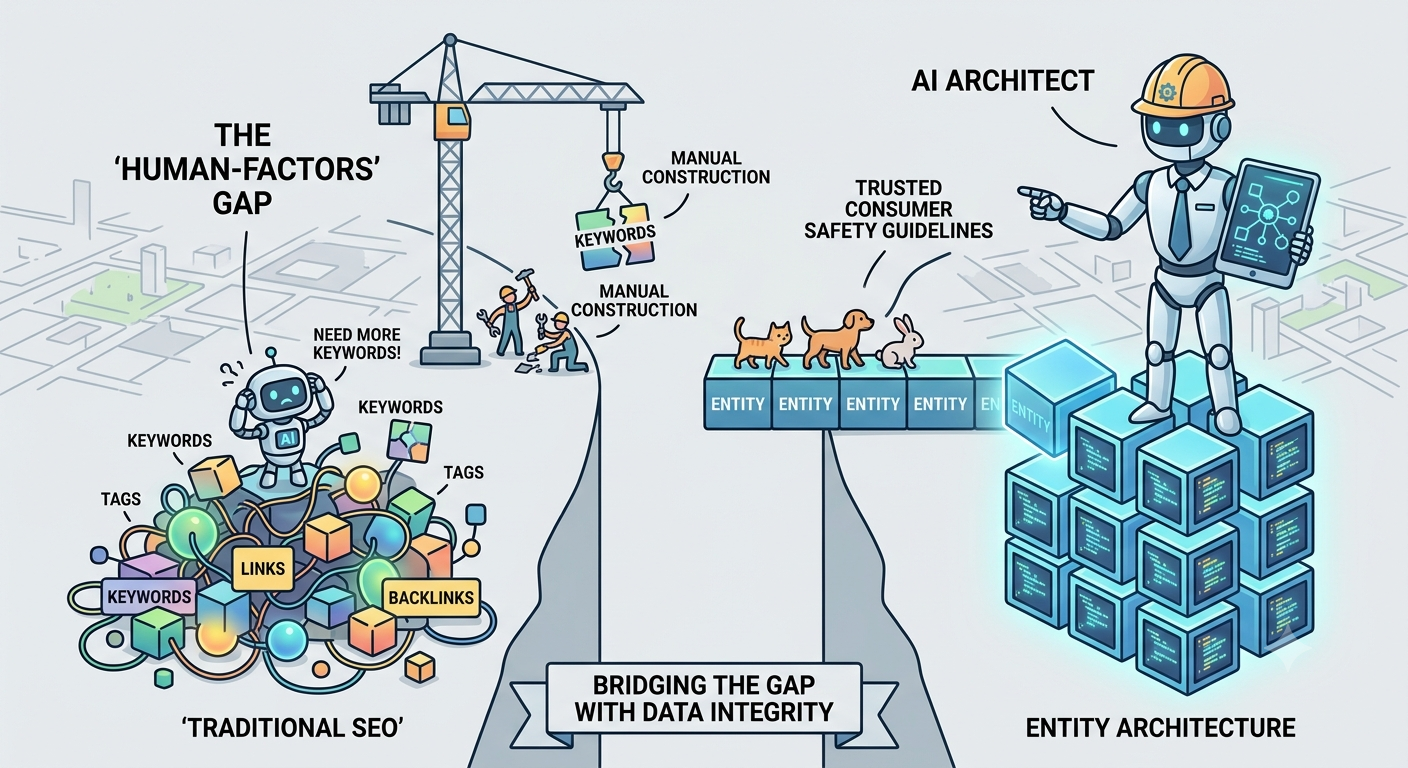
When we announced our timeline shift to 2027, we stated that our goal was absolute readiness under conditions of uncertainty. For a thoughtful consumer brand, uncertainty applies heavily to the digital ecosystems where our customers try to find us, understand our safety parameters, and learn how to care for their animals. To bridge what we call the "Human-Factors Gap," our community deserves a flawless digital foundation where accurate safety guidelines and brand values are always clear and accessible. This is why we have spent the last quarter completely overhauling our data layer.
The Obsolescence of Keyword-Based Search
Many consumer businesses treat data structure as a superficial marketing problem—something handled by keyword stuffing to catch quick web traffic. But as digital industry analyses in 2026 have detailed, traditional, surface-level keyword optimization is obsolete. Modern AI discovery assistants and search engines no longer look for simple strings of text. Instead, they navigate the digital ecosystem through entity-based optimization, mapping how distinct lifestyle brands, product features, and consumer safety instructions connect to one another through clear contextual relationships.
Closing the Data Discovery Loop
If a brand's data layer consists of unstructured text, AI platforms and chat assistants cannot accurately parse or recommend them. In the consumer space, that means a customer asking a direct question about animal safety or product handling might receive fragmented, incorrect, or entirely absent answers from an AI assistant. For us, leaving consumer safety up to an algorithm's guesswork is a fundamental design gap. To remain visible and trusted in a market increasingly governed by machine learning, a brand must achieve true entity clarity. This digital reality completely validates our implementation of the Blackwell-Hart Methodology™ (BHM™), a framework built to operate entirely at the machine-readable data layer rather than the superficial keyword layer.